EuroMOMO Bulletin, Week 16, 2024
EuroMOMO pooled estimates show normal levels of excess mortality
This week’s overall pooled EuroMOMO estimates of all-cause mortality for the participating European countries are within expected levels.
Data from 25 European countries or subnational regions were included in this week’s pooled analysis of all-cause mortality.
Norway has returned to the network
The EuroMOMO hub is delighted to announce the return of weekly data from Norway after a period of absence. Norway’s renewed participation strengthens our collaborative efforts in monitoring and addressing public health challenges across Europe.
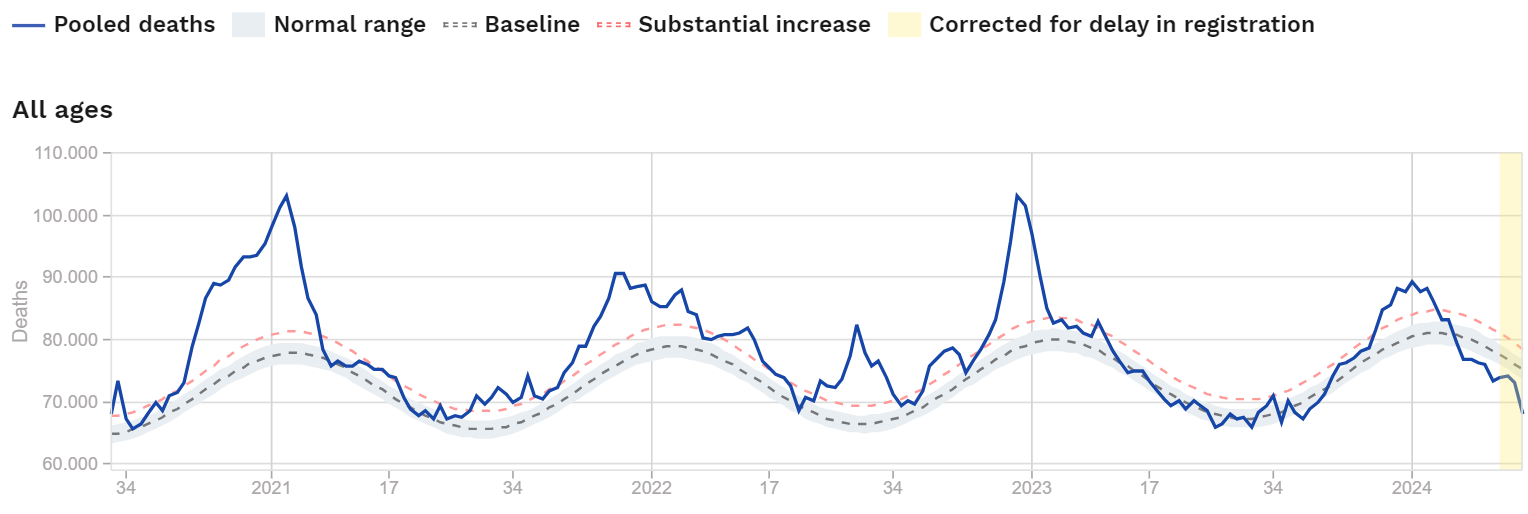 Note on interpretation of data: The number of deaths shown for the three most recent weeks should be interpreted with caution, as adjustments for delayed registrations may be imprecise. Furthermore, results of pooled analyses may vary depending on countries included in the weekly analyses. Pooled analyses are adjusted for variation between the included countries and for differences in the local delay in reporting
NOTE: As of week 14, 2024, data from the Netherlands has been improved, why there may be small differences to previously reported data from the Netherlands.
Regional German data from Berlin and Hesse no longer included
A timely surveillance of mortality was established in Berlin and Hesse long before whole Germany was reporting to EuroMOMO. The COVID-19 pandemic changed this and since May 2020 timely data for Germany is shown at the EuroMOMO platform. For this reason the regional monitoring for Berlin and Hesse ended in week 12/2024
After 3 years with the COVID-19 pandemic, data from spring 2023 and onwards are now included in the estimations of the expected mortality
After a long period with elevated overall European mortality through the COVID-19 pandemic, the European mortality (both totally for the entire population and in all age groups) was by spring 2023 within the expected level. Therefore, data from spring 2023 and onwards are now included in the estimations of the expected mortality.
During the pandemic years, the usual patterns of mortality were disrupted because of the unexpected and varying excess mortality experienced through the COVID-19 pandemic. This imply, that the assumption that there is no elevated mortality in certain weeks in spring (week 16-25) and autumn (week 37-44) does not hold. Therefore, to avoid biasing the estimations of the expected mortality, data from the pandemic years (2020-2022) are excluded from the estimations of the expected mortality.
Normally, the estimation of the expected mortality is based on data from a five-year period. However, when data from the three pandemic years are excluded from the estimations, the oldest data currently used is up to 8 years old. This means that until 2028, both data from the pre- and post-COVID-19 pandemic periods will be included in the estimations of the expected mortality. In the beginning, the pre COVID-19 period will have the greatest influence on the estimations of the expected mortality (it will have a heavier weight than the post pandemic period since there will be more pre COVID-19 years than post COVID-19 years). Gradually, the weight will shift towards the post-pandemic period and by autumn 2025 at the latest, the post-pandemic period will have a greater influence on the estimations of the expected mortality than the pre-pandemic period.
The inclusion of post-pandemic data, and the exclusion of the pandemic years from the estimation of the expected mortality might have an impact on the weekly estimates produced/shown by the EuroMOMO. Since the excess mortality is calculated as the difference between the observed number of deaths and the estimated expected number of deaths, these estimates together with the estimates of cumulated excess mortality might be affected as well.
Note about data from Ukraine
The EuroMOMO hub regrets to inform that weekly data from Ukraine will not be provided in the coming period, due to the current war in Ukraine.
About EuroMOMO network data sharing and collaboration
During the current COVID-19 pandemic, information on its mortality impact is of major concern. The EuroMOMO network hub receives many questions about the weekly mortality data we present, as well as requests to share the underlying national data. While the network fully supports data sharing, the network hub is not mandated by the participating countries to release any national data. If you are interested in accessing national data, please approach countries individually.
The EuroMOMO network welcomes collaboration with external partners, e.g. about additional analyses and modelling to be performed. If you are interested in engaging with the network about any such collaboration, please forward your ideas to the hub, for wider sharing and dialogue with the network.
Kindly note that any use of data or information originating from the EuroMOMO website must be appropriately quoted and acknowledged.